The Morning of the Cutouts
THIS IS A WORK OF FICTION
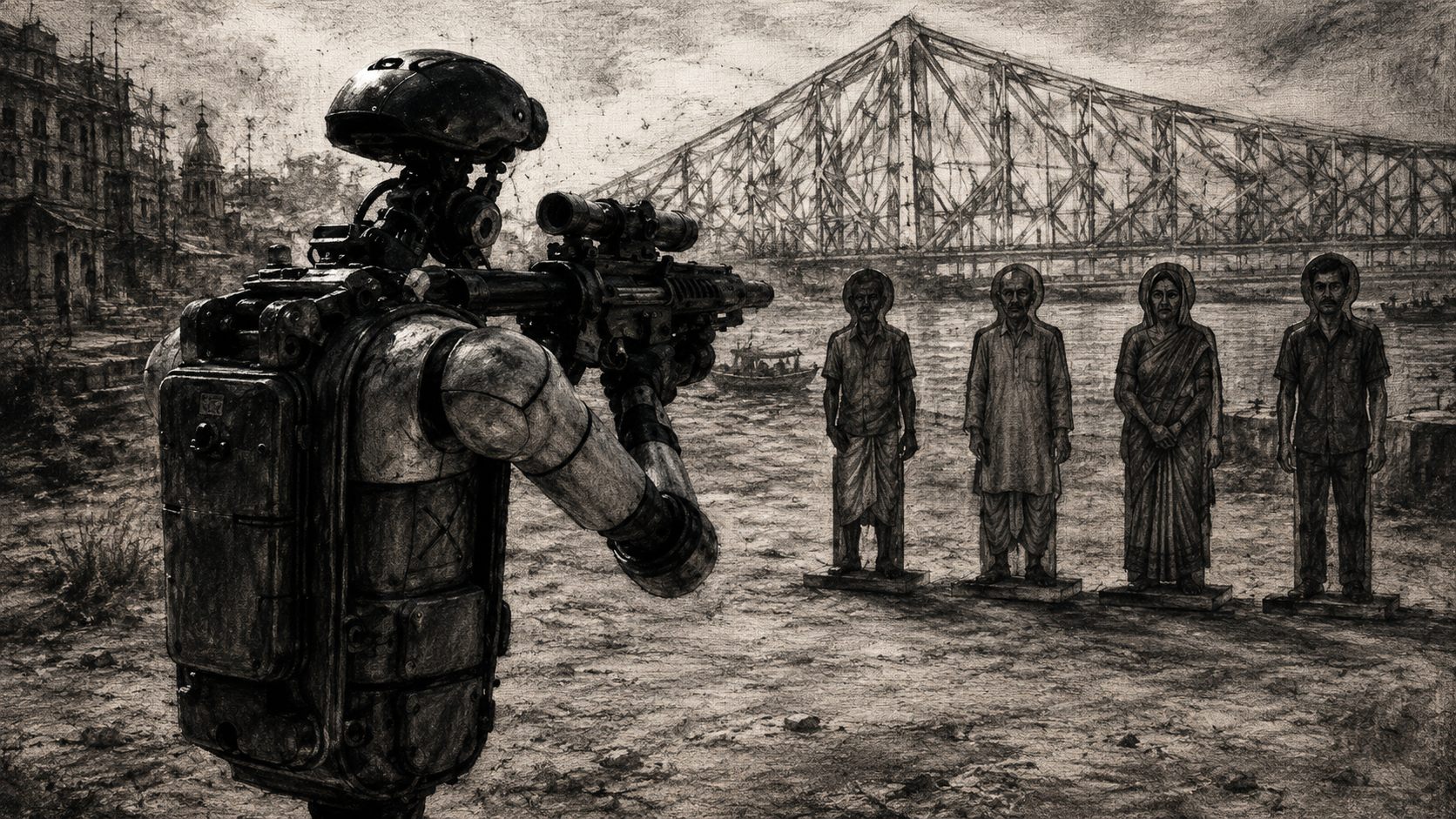
Tuhin woke because the morning had forgotten how to be morning.
There was no aluminum clang of buckets at the tap. No aunties fighting with the precision of High Court lawyers over whose turn it was. No pressure cooker whistle from Munni-di’s room, no cough from Khokon-kaku’s tea stall, no local train shrieking like a wounded animal pulling itself into Howrah station. Even the crows, those black-uniformed inspectors of Calcutta’s moral condition, were absent.
Only rain.
Not proper rain, either. Not the noble monsoon, coming with drums and declarations. This was leftover rain, thin and suspicious, slipping from the torn blue tarpaulin above him, gathering on the edge, then falling into the dented steel plate near his foot with a patient tick.
Tuhin sat up.
Their room was six feet by eight, if measured by a generous man with political ambitions. The wall was corrugated tin on one side, damp brick on the other, and one corner always smelled of kerosene no matter what his mother did. His schoolbag hung from a nail. His mother’s sari, the green one with yellow flowers, was missing from the rope. Her sandals were gone too.
“Ma?”
The word entered the room and came back embarrassed.
He stood, ducking under the low roof. His phone lay beside him, dead, its cracked screen a small black pond. Last night there had been a power cut, then shouting near the bridge, then a white light moving over the roofs. He remembered his mother shaking him.
“Sleep, Tuhin,” she had said. “If anyone asks, you are not here.”
That made no sense now. Adults always produced these sentences during trouble, as if children could become invisible through obedience.
Outside, Nandipara Colony had vanished without leaving.
Not the houses. The houses remained, if those leaning arrangements of tin, tarpaulin, bamboo, plywood, political banners, and stubbornness could be called houses. The lanes remained: narrow, wet, full of plastic slippers, paan stains, torn snack packets, and the delicate electrical wiring by which men who could barely pay rent borrowed lightning from the state. But the people were gone.
Every door hung open.
Every stove was cold.
A pot of rice sat half-washed near the tap. A child’s red frock lay in the mud as if dropped by a mother who had suddenly remembered another life. Someone’s old transistor radio sat on a stool, silent, its antenna raised toward a sky that had no useful answers.
Tuhin walked barefoot through the lane. Mud squeezed between his toes. He should have heard somebody by now. Old Buro-mashi, who knew the private sins of every household from Shibpur to Sealdah, should have leaned over her balcony and said, “Ei, why are you wandering like an orphan ghost?” Khokon-kaku should have been pouring tea into little glass cups, discussing petrol prices, cricket, and the end of civilization with equal confidence.
But Khokon-kaku’s stall was shuttered.
On the shutter someone had pasted a fresh notice, the paper already softening in the rain.
REDEVELOPMENT CLEARANCE ZONE
UNAUTHORIZED STRUCTURES REMOVED UNDER PUBLIC SAFETY ORDER
SETU VISTA URBAN RENEWAL PROJECT
Under it, in red paint, someone had written: DEVELOPMENT MEANS DISPLACEMENT WITH BETTER ENGLISH.
Tuhin stared at the words. He had heard of Setu Vista. Everyone had. For two years men in clean shirts had come with tablets, measuring tapes, and smiles thin enough to cut fish. A gated tower was coming, they said. River view flats. Sky garden. Retail promenade. Jobs for locals. Proper rehabilitation. The phrases had floated over the colony like puja balloons, bright and useless, until one by one they burst.
Still, no demolition had happened. Not yet. There had been meetings, petitions, arguments, one police lathi charge, two newspaper articles, and a visit from a local councillor who said, “Nobody will be moved without dignity,” which in Calcutta generally meant the dignity had already been subcontracted.
Tuhin ran toward the river.
The lane opened near the ghat, where Howrah Bridge rose beyond the mist, enormous and unsentimental, a steel animal crouched over the Hooghly. Buses groaned somewhere above. Horns barked. The city had not ended. That was the first terrible thing. The world was continuing, very busy, quite satisfied.
A delivery rider in a yellow raincoat zipped past on the main road, phone mounted before him like a temple idol. Two men pushed a handcart stacked with sacks of onions. A taxi driver spat expertly into the drain. Far away, a metro announcement dissolved into static from someone’s shop radio. Calcutta, that old magician, was still pulling coins from behind everyone’s ear.
Only Nandipara was empty.
Then he heard the gun.
Not a police gun. He knew that crack from videos and election nights. This was softer, mechanical, almost polite.
Thup.
Then a whirr.
Then thup-thup-thup.
Tuhin crouched behind a broken concrete pillar and looked toward the open ground near the river, where the boys played cricket when the mud allowed and where, during Durga Puja, a small pandal rose every year with heroic ambition and very poor wiring.
A humanoid robot stood there.
At first his mind refused the word. Robot belonged to YouTube, to Japanese factories, to American films where men in sunglasses saved cities that looked nothing like Howrah. But this thing was unmistakable. It stood taller than any man in the colony, broad-shouldered, black and grey, with jointed arms and a smooth helmet-shaped head. Rain ran down its metal body. On its chest, in white stencil, was written:
NANDI-07
CIVIC RESPONSE UNIT
One of its arms held a long training rifle with a fat barrel. The other adjusted a rack of targets.
Human targets.
Paper cutouts.
They stood in a line on thin wooden stands, trembling in the rain. Full-size printed figures. Men in lungis. Women in faded saris. Children with schoolbags. Old people with bent shoulders. So detailed that for one mad second Tuhin thought they were real people pretending to be paper.
Then the robot raised the rifle and fired.
Thup.
A white pellet struck the chest of a cutout.
The paper figure jerked backward, folded, and fell.
The robot’s head rotated slightly. A blue light moved across the remaining targets.
“Scenario repeat,” it said, in English first, then in careful Bengali. “Unauthorized crowd formation. Dispersal sequence. Non-lethal priority.”
It fired again.
This time Tuhin recognized the target.
Khokon-kaku.
Not just a general tea seller. Khokon-kaku exactly: white vest, towel on shoulder, left eye smaller than the right, belly pushing against his lungi with comic optimism. Even the old burn scar on his forearm was there.
The pellet tore through paper Khokon’s mouth.
Tuhin bit his own knuckle to keep from shouting.
There were others. Munni-di, holding her red market bag. Buro-mashi with her walking stick. The twins from the next lane, both printed in mid-laughter. A rickshaw-puller named Salim with his green gamchha. His mother.
Tuhin stopped breathing.
Piyali Dutta stood among the targets, paper hands folded at her waist, her green sari with yellow flowers printed so faithfully that even the darker patch near the border, where cooking oil had once spilled, was visible. Her eyes looked tired. Not frightened. Just tired in the way women became tired when the rice tin was low, the landlord was rude, the doctor wanted cash, and the son needed exercise books because schools had discovered the profitable mystery of new editions.
The robot aimed at her.
“No,” Tuhin whispered.
The robot paused.
Its head turned.
The blue light found him behind the pillar.
For a moment neither moved. Rain ticked on tin, river, rifle, boy.
“Unregistered child detected,” the robot said. “Please remain outside active training zone.”
“Where is everyone?” Tuhin shouted.
The robot lowered the rifle one inch. “This site has been cleared.”
“Where?”
“Cleared.”
“That is not a place.”
“Statement acknowledged.”
Tuhin stood up because terror and anger, when mixed in a small body, sometimes produce foolish courage. “That is my mother.”
The robot looked at the paper Piyali, then back at him. “Civilian likeness asset. Category: adult female, informal settlement resident, resistance probability medium.”
“Her name is Piyali.”
“Name metadata unavailable in operational mode.”
“You are lying.”
“I do not lie.”
This, Tuhin thought, was exactly what a liar would say if built by educated people.
He knew machines a little. Not properly, not like the boys who went to coaching centers with glass doors and air-conditioning and fathers who said “my son is doing robotics” at weddings. Tuhin knew machines as poor boys know them: by opening dead ones. Phones, mixer grinders, LED bulbs, Bluetooth speakers, old routers thrown out by offices in Dalhousie. He had a screwdriver, two magnets, copper wire, and a dream that smelled of burnt plastic.
Six months earlier, a man called Mr. Sen had come to Nandipara with a tablet.
“Digital survey,” he said. “For rehabilitation. Face photo, Aadhaar, household details. Very simple. Those who cooperate will be processed first.”
He wore perfume and brown shoes that did not understand mud. The residents distrusted him, naturally. Then he hired Tuhin for two days.
“You are educated,” Mr. Sen told him. “Class Eight, no? You explain to them. Take photos. I’ll give you five hundred.”
Five hundred rupees. With five hundred rupees a boy could buy a cheap robotics kit from Chandni Chowk Market. Not a real one, but enough motors to make a wheeled thing move forward and collapse sideways like a drunk beetle.
So Tuhin had gone door to door.
“Just photo, Khokon-kaku. For list.”
“Buro-mashi, look here. No, not like passport. Smile if you want.”
“Ma, everyone is doing. Why are you making drama?”
His mother had slapped him that evening. Not hard. Worse: sadly.
“You think they need your photo to help you?” she said. “They need your photo to count you properly when they throw you away.”
He had not answered. The robotics kit arrived three days later.
Now the robot walked to the fallen paper Khokon, lifted it with two fingers, and clipped it back to the stand.
“Move aside,” it said. “Training will resume.”
Tuhin stepped into the ground.
The robot’s rifle rose but did not fire.
“Why are you not shooting me?”
“Unregistered child detected. No likeness asset. No engagement protocol.”
“No likeness?”
“Face not matched.”
That was impossible. Mr. Sen had photographed him too, laughing. “Future engineer,” he had said. “We must include talent.”
Tuhin touched his face. It felt normal: wet skin, sharp nose, small scar near his eyebrow from a kite fight on Makar Sankranti.
He backed away and ran.
He searched the colony properly then, house by house. In Munni-di’s room the television was gone but the wall calendar remained, showing a goddess smiling over a finance company advertisement. In Salim’s hut a prayer cap lay on the cot. At Buro-mashi’s place, a steel trunk had been opened and emptied, but her framed photo of a dead husband was still hanging crookedly. People take gods, documents, money, medicines, and sometimes pressure cookers when they flee. They do not take everything and leave the dead husband.
Near the community toilet, Tuhin found drag marks in the mud.
Not feet.
Something broad had passed there. Wheels, maybe. Or stretchers.
He followed the marks behind the row of huts, to the old warehouse wall where children wrote dirty jokes and political parties wrote cleaner lies. There, half-hidden under a blue plastic sheet, he found stacks of paper cutouts.
Hundreds.
Some blank white at the back. Some printed with faces he knew. Some already torn. And at the edge of one stack, a label:
SETU VISTA / CIVIC RESPONSE TRAINING PACK
SOURCE: COMMUNITY ENUMERATION MEDIA
ANNOTATOR: T. DUTTA
SIMULATION RUN: 3091
His name was not written fully, but it did not need to be. Guilt is a very good autocomplete.
He pulled the sheets apart, shaking. There was paper Khokon. Paper Munni. Paper twins. Paper Ma. Their lives had been flattened into target practice: posture, height, clothing, probable resistance, best angle for dispersal.
This was what modern life had done, he thought, with a bitterness too old for him. Earlier the poor were invisible. Now they were visible in high resolution, from five angles, with metadata. The improvement was mainly useful to people holding clipboards, tablets, guns, and PowerPoint presentations.
At the bottom of the stack he found a cutout facedown.
Smaller than the others.
His own height.
He did not turn it over at once.
The rain thickened. Above the bridge, traffic moved through mist. A bus honked like an insult. Somewhere a temple bell rang, absurdly calm.
Tuhin lifted the cutout.
It was blank.
Just white.
He laughed then, once, a cracked little sound. No likeness asset. The machine had said so. He was safe because the system had lost him. In a city where everyone wanted documents, certificates, QR codes, OTPs, tokens, forms, and proofs of proof, he had become nothing.
Nothing could survive.
He dragged the blank child cutout with him back to the ground.
NANDI-07 was firing at his mother now. Pellet after pellet struck around her, testing distances. Her paper sari fluttered.
“Stop,” Tuhin said.
“Do not obstruct civic procedure.”
“This is not civic. This is murder rehearsal.”
“Incorrect. No living persons present.”
“Where are they?”
The robot’s blue light narrowed.
“Relocation completed at 03:17 hours.”
“Where?”
“Transit facility.”
“Which one?”
“Data unavailable.”
“Were they alive?”
The robot paused long enough for the answer to become an answer.
“Relocation completed,” it repeated.
Tuhin walked to the paper image of his mother. Up close, the print was so good that her eyes seemed almost wet. A strand of hair had escaped near her forehead. He remembered that strand. It never stayed pinned. In summer she would blow upward at it while cutting vegetables.
“I am taking her,” he said.
“Asset removal prohibited.”
He pulled the paper Piyali from the stand.
The robot moved fast. Its left hand clamped around his wrist, not crushing, but with the calm authority of something designed by people who had never been held by police.
“Release asset.”
“She is not an asset.”
“Civilian likeness asset.”
“She is my mother!”
His voice broke across the empty ground.
The robot held him. Its face had no eyes, only the blue scanning bar. He saw himself reflected in the wet black helmet: small, muddy, hair sticking up, mouth open.
Then the reflection flickered.
For one second, he did not see a boy.
He saw a flat white shape.
Tuhin went still.
The robot released him.
“Anomaly stabilized,” it said.
“What anomaly?”
“Witness layer.”
The words meant nothing. They meant everything.
Tuhin looked down at his wrist. Where the robot had gripped him, the skin had not reddened. It had creased.
A fine white crease ran across him, like folded paper.
He rubbed it. The crease remained.
“No,” he said softly.
The robot turned toward the targets. “Scenario repeat.”
Tuhin stumbled backward. His foot caught on the blank child cutout he had dropped. It flipped in the mud.
Not blank now.
His own face stared up at him.
Not a photograph exactly. Too clean. Too bright. The printed Tuhin stood with his schoolbag, chin lifted, trying to look clever. Future engineer. There was the scar near the eyebrow. There was the cheap blue shirt. There was the little smile he had given Mr. Sen because five hundred rupees was five hundred rupees, and because a boy must sometimes betray a world in order to buy a smaller one with batteries.
Below the printed feet ran a line of tiny text.
T. DUTTA
MINOR ENUMERATOR
STATUS: DECEASED IN CLEARANCE FIRE
RETAINED AS TRAINING WITNESS
He remembered the white light then.
Not from a vehicle.
From flames.
Last night was not last night. Last night had happened many mornings ago. A cylinder bursting near Khokon’s stall. Tarpaulin catching. People shouting. His mother pushing him under the cot, pressing the wet end of her sari over his mouth. Smoke lowering itself into the room like a landlord taking possession. His phone in his hand, still recording because that is what boys do now: they record disaster first and understand it later.
The data had survived.
Perhaps that was the miracle. Perhaps that was the crime.
The robot fired again.
Paper Piyali folded neatly at the heart.
Tuhin did not scream. Paper has no proper lungs for it. He only stood in the rain near Howrah Bridge, while the city crossed above him in buses and taxis and office shoes, while the river carried flowers, oil, ashes, and plastic bottles toward the sea, while NANDI-07 reset the targets for another morning.
When the wind shifted, Tuhin became very thin. For a moment he could see the bridge through his own hand.
Then he bent, picked up his mother’s fallen cutout, and held it against his chest until both of them softened in the rain, their printed colors running together as if, at last, the machine had found a category for grief.